
Regional Collaboration Advancing Ocean Observation and Forecasting in the Southeastern Pacific: The SEPICAF Project
For eight years, the SEPICAF project (South Eastern Pacific Circulation from Argo Floats) has contributed to the Argo program, which monitors global ocean circulation from the surface down to 2000 m depth, by coordinating the deployment of 37 profiling floats off the coasts of Peru and Chile. In this region—highly exposed to extreme climate events and crucial for global climate regulation—SEPICAF has significantly strengthened ocean observing and forecasting capacity. By expanding sustained observations, the project has helped lay the foundations for more reliable ocean predictions and enhanced societal preparedness along the coasts of Peru and Chile.
Between 2020 and 2025, SEPICAF deployed 37 Argo floats in the southeastern Pacific—one of the least instrumented yet most climatically sensitive ocean regions. By expanding the regional observing system, the project significantly improved real-time monitoring of ocean circulation, temperature, salinity, and dissolved oxygen. These observations directly feed ocean reanalyses and forecast systems, enhancing their accuracy and reliability.
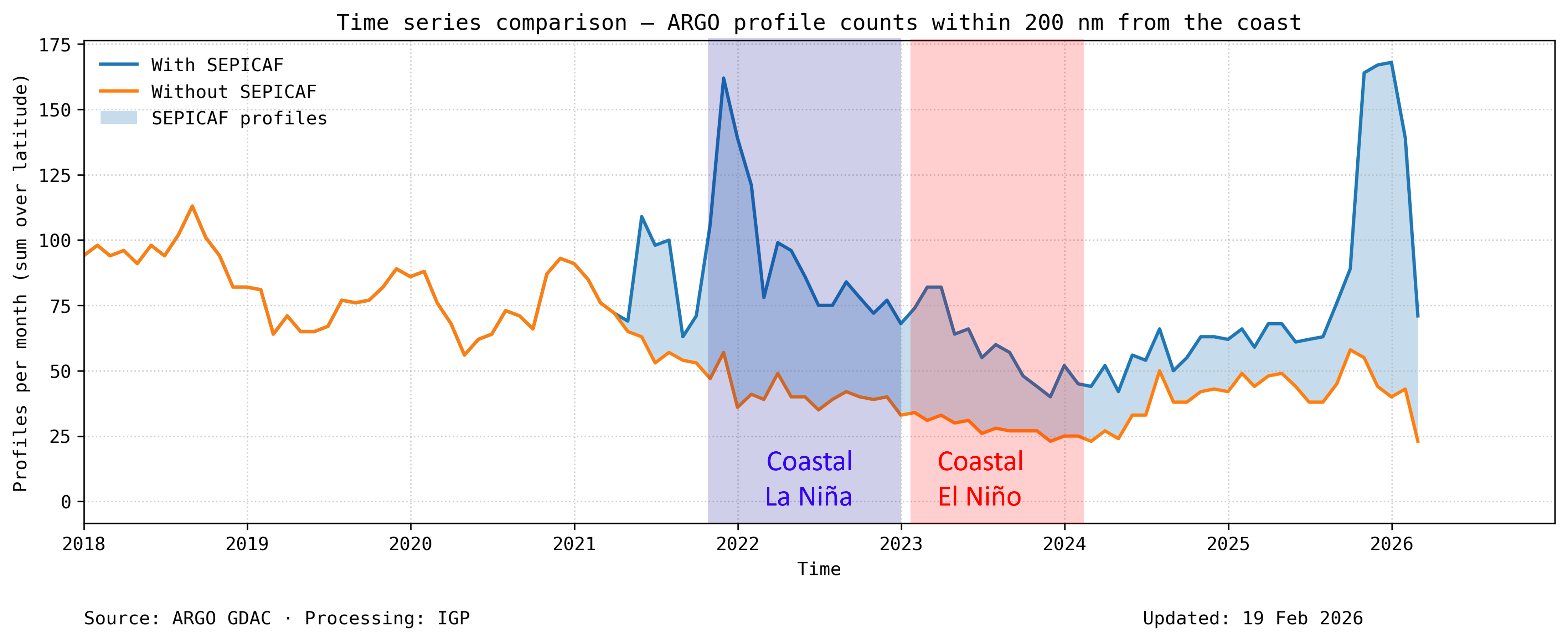
Evolution of the number of Argo profiles off the coast of Peru (first 200 miles from the coast) from 2018 showing the contribution of the regional program SEPICAF.
A major scientific contribution of SEPICAF has been advancing understanding of the Oxygen Minimum Zone (OMZ), one of the largest and most intense in the world. By clarifying how ocean circulation and El Niño events drive oxygen variability, the project has improved the capacity of models to represent these processes. This progress is essential for anticipating the future evolution of low-oxygen waters under climate change, with direct implications for fisheries, ecosystems, and coastal livelihoods.
SEPICAF has also strengthened the monitoring and understanding of Coastal El Niño events—short-lived but high-impact marine heatwaves that can cause flooding, droughts, and severe socio-economic disruption in Peru and Chile. By providing sustained ocean observations, the project has enhanced the ability of forecasting systems to detect and anticipate such events, supporting earlier warnings and better-informed decision-making. This effort has been complemented by an ANID-funded project (N°1231174) dedicated to investigating Coastal El Niño dynamics using a range of modeling resources.
Beyond research, SEPICAF has played a key role in connecting science with operational forecasting and community needs. In Peru, Argo data are actively used by ENFEN (The Multisectoral Commission in Charge of the National Study of the El Niño Phenomenon), the national El Niño monitoring and advisory group, in collaboration with the Geophysical Institute of Peru. In Chile, Argo observations have provided valuable complementary data for validating an ocean prediction system developed by CEAZA for the coastal region of Coquimbo. The project has also built strong partnerships for float deployment and logistics, including collaboration with the fishing company TASA, the Peruvian Marine Research Institute (IMARPE), and the Directorate of Hydrography and Navigation of the Peruvian Navy (DIHIDRONAV). In Chile, partnerships include CEAZA, the University of Coquimbo and the University of Concepcion. These collaborations demonstrate how academic, governmental, and private-sector actors can work together to strengthen ocean resilience.

Through its contributions to regional observing capacity, forecast system improvement, and international initiatives under the United Nations Decade of Ocean Science, such as OPDCC and CLAP, SEPICAF has reinforced the southeastern Pacific’s role within the global ocean observing community. By enhancing ocean forecasting capabilities and fostering collaboration, the project helps ensure that scientific advances translate into tangible societal benefits.
Useful links:
SST forecasts from the prediction developed at CEAZA: https://www.ceazamar.cl/pronosticos/pronostico-regional-tsm/
Monitoring of ocean conditions from Argo data at IGP : http://met.igp.gob.pe/variabclim/argo.html
Partners:
CEAZA, IGP, University of Coquimbo, University of Concecpion, TASA, IMARPE, DIHIDRONAV


Contributed articles reflect the views of their authors and do not necessarily represent those of the OceanPrediction Decade Collaborative Centre or its partners. Content is not independently fact-checked or peer-reviewed by the Centre.
Follow us